City – Country – Resonance
Printmaking from the Historic Artists’ Colony
The early 20th century was a period in which printmaking established itself as an independent art form, moving far beyond reproduction or mere illustration and opening up new modes of expression for modern art movements. At the beginning of the 20th century, new artistic possibilities were developed for established techniques such as etching, lithography, and woodcut.
Artists of the Schwalenberg artists’ colony also explored the medium of printmaking, particularly etching and linocut or woodcut techniques. These works contributed significantly to the growing recognition and popularity of Schwalenberg within the art world: Schwalenberg motifs shown, for example, at the Great Berlin Art Exhibition attracted other artists to the town and the surrounding region — printmaking opened a gateway to the world for Schwalenberg.
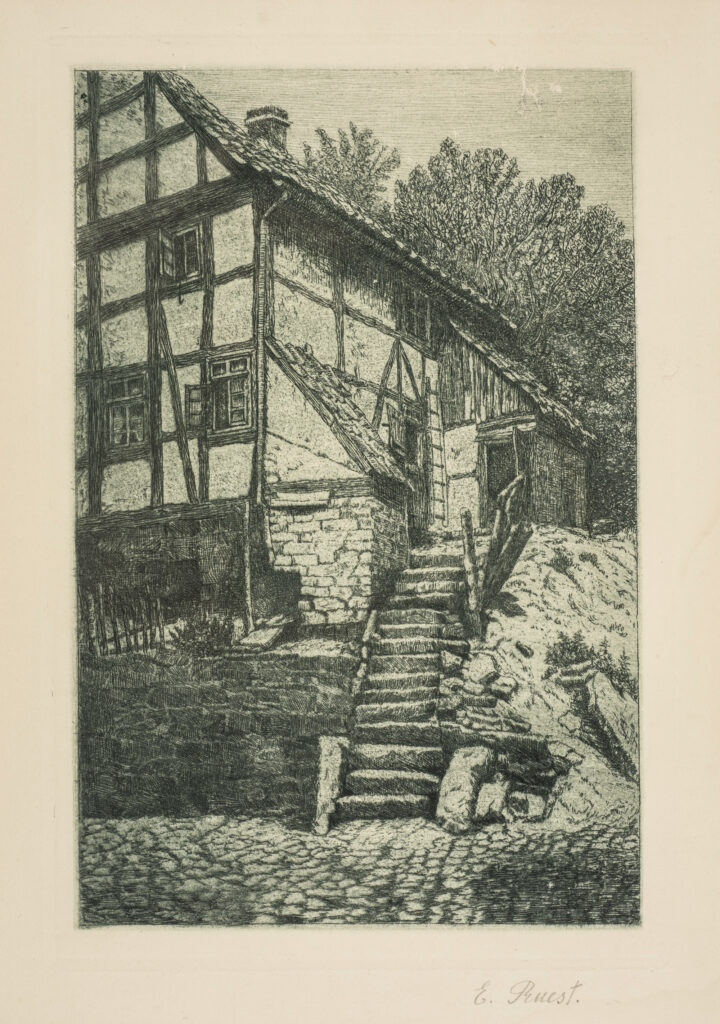
The exhibition presents prints from the flourishing period of the painters’ town of Schwalenberg, with a focus on works by Magnus Zeller (1888–1972), Elisabeth Ruest (1861–1945), and Robert Kämmerer-Rohrig (1893–1977).
Image: Elisabeth Ruest, Half-Timbered House with Stone Staircase in Schwalenberg, etching, undated. Collection of the Municipal Gallery Schwalenberg. © Photo: Jürgen Ihle.