The Fabulous Albums of Alfred Mayer, Friend and Patron of Der Blaue Reiter
With its new special exhibition, the Schloßmuseum Murnau puts the spotlight on a fascinating figure who has remained largely hidden from scholarship until now: the theatre critic and art writer Alfred Mayer (1860–1932), who, as a supporter and patron, gathered renowned cultural figures around him. The Schloßmuseum holds three artists’ albums and a photo album from the estate of Mayer and his daughter Eva (1917–2008). The albums came into the museum’s collection in 2015 and 2024 respectively, by two different routes, but both times as donations from private ownership.
Leafing through the books, it becomes clear that these three artists’ volumes are far more than mere guest books; they resemble artistic friendship albums, in which painters, writers, theatre people, composers and musicians dedicated to Alfred Mayer very personal testimonies of their work, ranging from handwritten notes to collages and delicate drawings. The names read like a who’s who of the art and cultural scene of the time: Else Lasker-Schüler, Klabund, Joachim Ringelnatz, Arthur Schnitzler, Heinrich Mann, Gabriele Münter, Alexej von Jawlensky, Marianne von Werefkin, Marieluise Fleißer, Hannah Höch and many more.
But who was Alfred Mayer, who saw himself more as a friend and mediator than as the centre of a network, and who, towards the end of his life, would gladly have established a foundation to support artists in need? Mayer was the son of a Jewish merchant family in Frankfurt. Instead of following the career mapped out for him in the family business, he was drawn to theatre and art. When he moved to Berlin in 1886, he initially worked as a merchant, but with hardly any financial security, he turned his passion into his profession and became a critic (over the course of his life, he would produce more than 100 publications). In Berlin, he met the theatre director Max Reinhardt, among others.
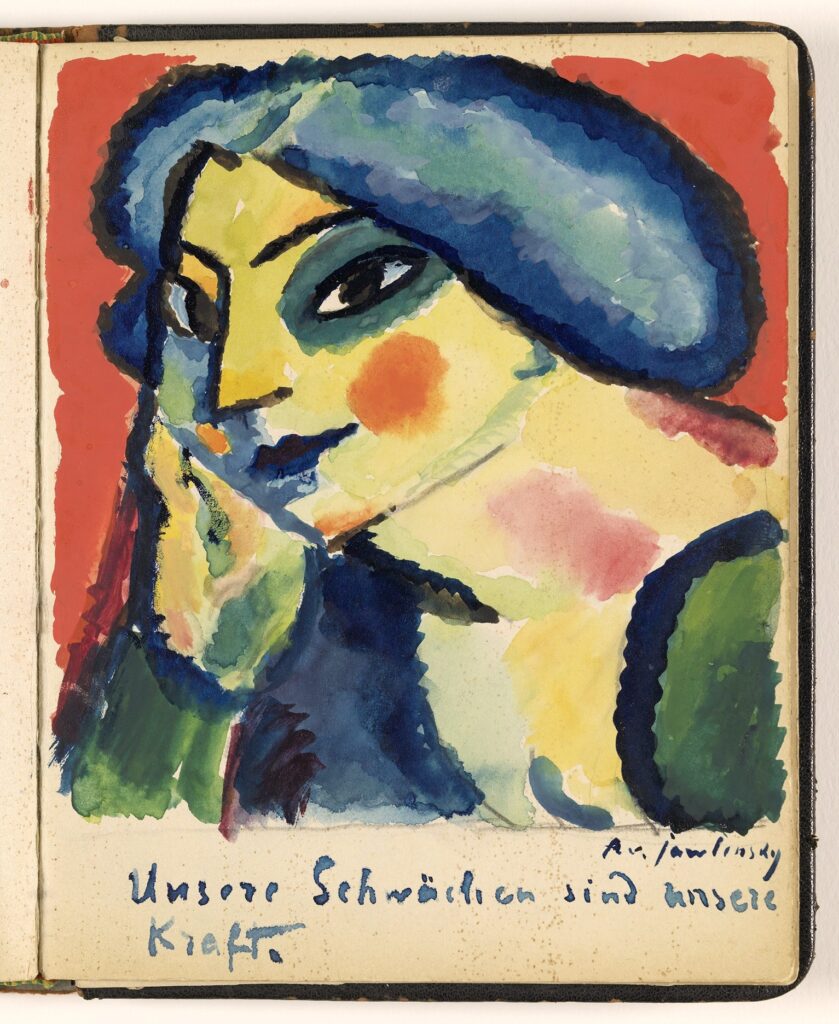
From 1906, Mayer lived in Munich-Schwabing as an art writer, theatre critic and collector. Here he was closely connected with the artists of Der Blaue Reiter and owned, among other works, Kandinsky’s Impression I, 1910 (destroyed in the Second World War), Paul Klee’s Still Life with Thistle Blossom, 1919, and, according to the recollections of his daughter Eva and the actress Berta Drews, who lodged with him for a time, four “strongly coloured female heads” by Alexej von Jawlensky. His albums, kept between 1900 and 1931, are a fascinating mirror of the artistic scene of the day and in places offer insights into works that were then in the process of being created.
The photo album, too, holds surprises. Alongside photographs of Franz and Maria Marc, Kandinsky, Werefkin, Jawlensky, Arthur Schnitzler, Lotte Pritzel and Olaf Gulbransson, among others, it contains two photographs of the doll maker Hermine Moos. She stands laughing on a balcony, next to a human skeleton she constructed herself: the underlying structure for the life-size doll that she made in 1918 on commission from Oskar Kokoschka, modelled on Alma Mahler.
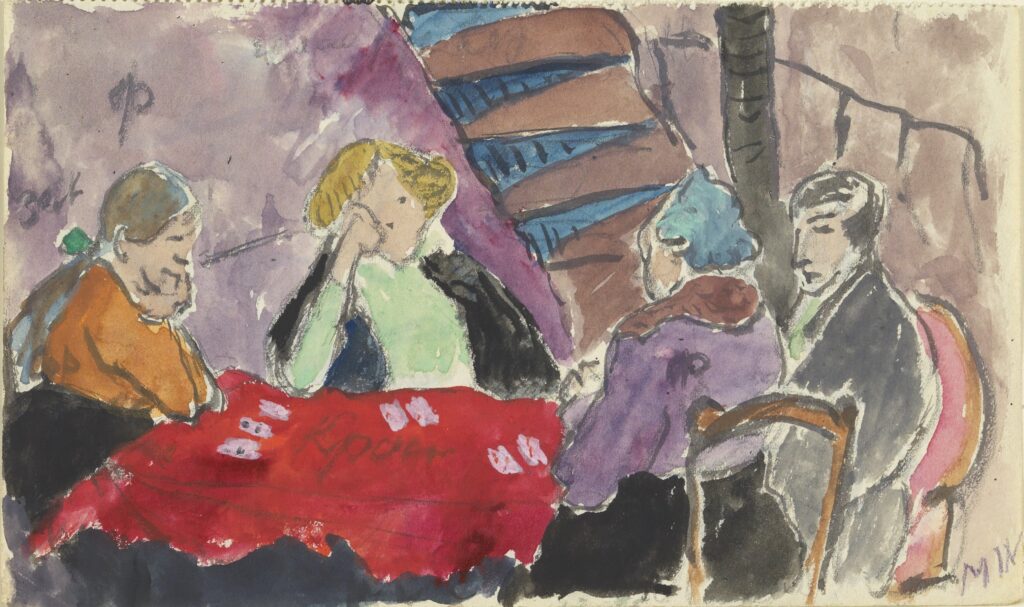
In Eva Mayer’s album, which she began keeping in 1926 at the age of nine, the artists immortalised themselves in a child-friendly manner, in some cases with multicoloured gouaches and watercolours. Marianne von Werefkin created a group of card players for Eva, Conrad Felixmüller portrayed the girl with a broken arm, and the actress Grete Jacobsen drew a hare for her in her arms at Easter.
Starting from these four albums, the Schloßmuseum Murnau, in collaboration with experts in theatre studies, literary studies and art history, traced Mayer’s work as a collector and patron. Enriched by focused loans, the special exhibition places at its centre a remarkable personality who has hardly been on the radar of scholarship until now.
https://schlossmuseum-murnau.de
Images:
Alexej von Jawlensky, Head Portrait, 1912, watercolour on paper, entry in Alfred Mayer’s Guest Book I, p. 116, Schloßmuseum Murnau, Photo: N. Steglich, Starnberg
Marianne von Werefkin, Card Players, 1930, gouache, entry in Eva Mayer’s Artist’s Album, p. 53, Schloßmuseum Murnau, Photo: N. Steglich, Starnberg
