News from Hiddensee. Island of Women Painters.
Artists’ colonies offered women artists of the early 20th century unique opportunities for training, artistic practice and exchange. In Worpswede and Dachau, Dangast, Ahrenshoop and Hiddensee, these centres of artistic activity took shape. The opportunity for artistic discourse, mutual inspiration and collective exhibition work were defining characteristics of an artists’ colony. Artists who had settled permanently and depended on earning a living often founded painting schools here, which in turn became gathering points for women artists. Paul Müller-Kaempff, for example, established the St. Lukas painting school in Ahrenshoop, and Otto Modersohn did the same in Worpswede. Before long, there were so many women artists in these colonies that the phenomenon earned them the label of “Malweib” — a term that carried with it no small amount of mockery and contempt.
The significance that Paris held in the early 20th century gradually shifted in the following decades to Berlin. The city became home to the artists’ associations of the “Secession” and “Neue Secession”, the “Brücke” and the “Sturm”. Many women artists were drawn to the metropolis of Berlin, which had now also become the capital of artistic development, and they brought their modern perspectives with them when they sought out idyllic settings like Hiddensee to paint the landscape.
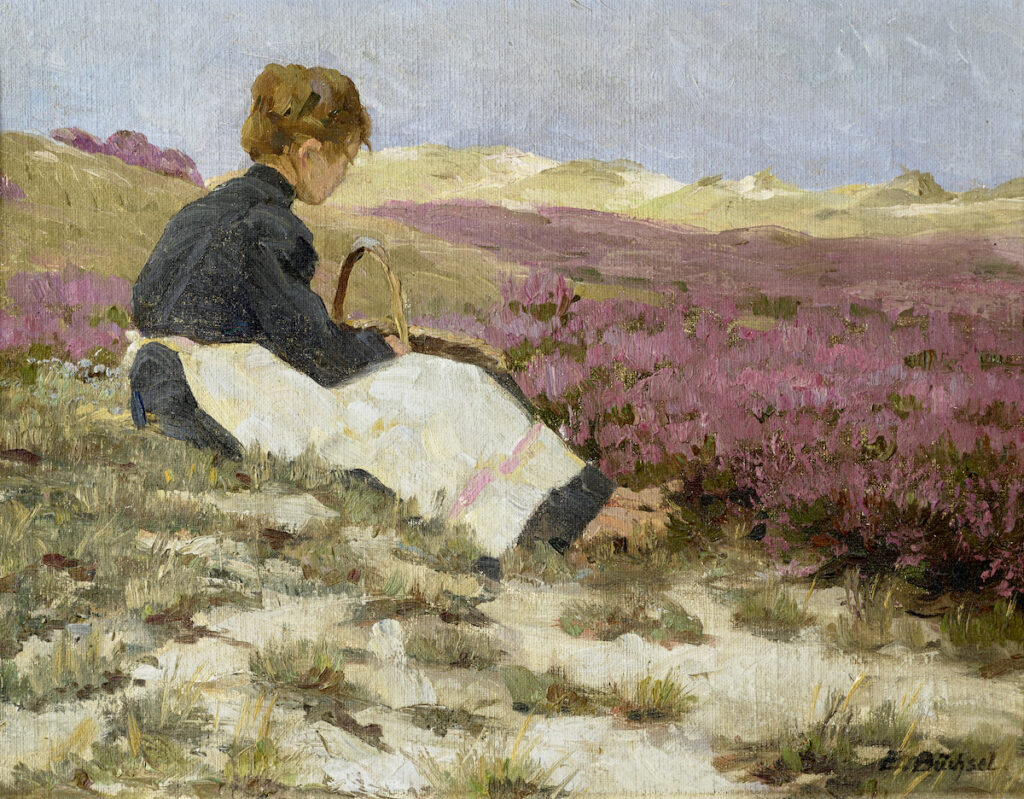
For a long time, women had to fight against the prejudice that they were only artistically active until they could marry — a pastime, so to speak, until their “true calling” in life. It was not uncommon for many to remain unmarried as a result. A closer look at the artists’ colony on Hiddensee reveals much the same picture. Elisabeth Büchsel received her training partly at the painting school of the Association of Berlin Women Artists before moving on to the private Atelier Colarossi in Paris, followed by a further period at the Academy of the Munich Women Artists’ Association. Elisabeth Büchsel, together with Clara Arnheim and Henni Lehmann, served on the board of the Hiddensee Women Artists’ League, founded in 1919 on the initiative of the painter Henni Lehmann. Further members included Käthe Loewenthal, Katharina Bamberg and Elisabeth Andrae, and later Julie Wolfthorn and Dorothea Stroschein. Together they exhibited in the Kunstscheune in Vitte, later known as the Blaue Scheune. At the beginning of the 20th century, Hiddensee was the summer meeting point for Berlin’s artistic avant-garde, making it a stage for modernism in the realm of women’s art.
In 1933 the Women Artists’ League was destroyed. A number of painters were classified as Jewish regardless of their actual religious affiliation and were forced to leave the island. Henni Lehmann took her own life in 1937; Clara Arnheim, Käthe Loewenthal and Julie Wolfthorn were persecuted and deported. Elisabeth Büchsel survived the Second World War and continued painting into old age. The Women Artists’ League could not be revived.
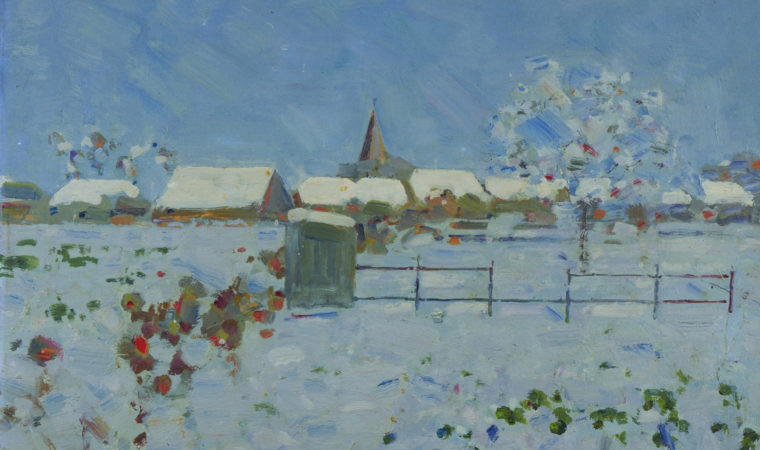
The exhibition “News from Hiddensee. Island of Women Painters” is dedicated exclusively to the women artists of the island, honouring their work and conveying the particular conditions under which it was created. On display are works — some never previously shown to the public — drawn from private collections and museum holdings.