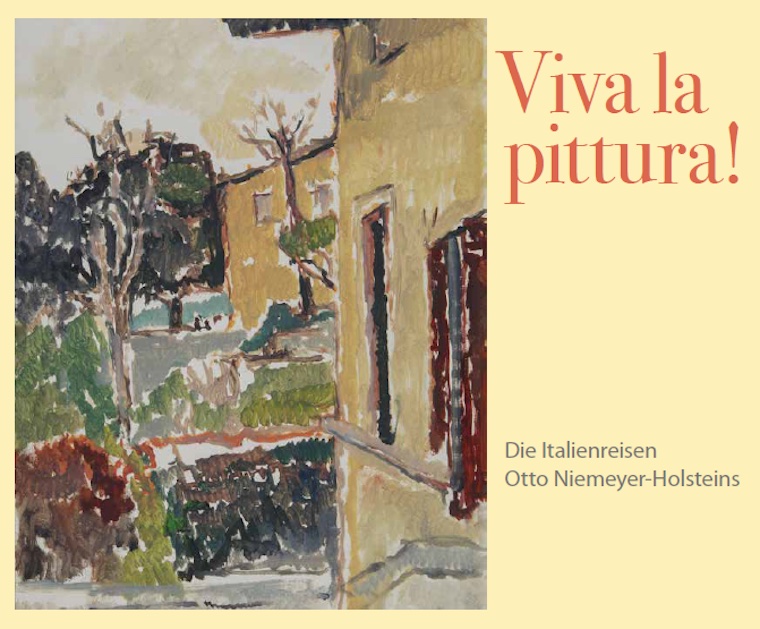
Viva la pittura! Otto Niemeyer-Holstein’s Journeys to Italy
Otto Niemeyer-Holstein (1896–1984) made repeated study trips to Italy to explore Roman antiquity, Renaissance culture, and the light and landscapes of the country — following in the footsteps of countless German artists and art lovers before him. Italy had always been the dream destination for visual artists, and a journey there was once considered an essential part of any artistic education.
His first trip to Italy, which resulted in drawings and watercolours, took him to Sicily in 1920. A second journey in 1930 appears to have left a particularly lasting impression. At the Villa Romana in Florence, he painted a work that became an emblem of these years of learning and wandering: his own worn-out shoes. The painting must have meant a great deal to him — he never sold it. In Florence he also encountered the painter Hans-Joachim Staude (1904–1973), who had grown up in Hamburg. Also noteworthy is his participation in the IV. Mostra Regionale d’Arte Toscana, held in Florence in 1930.
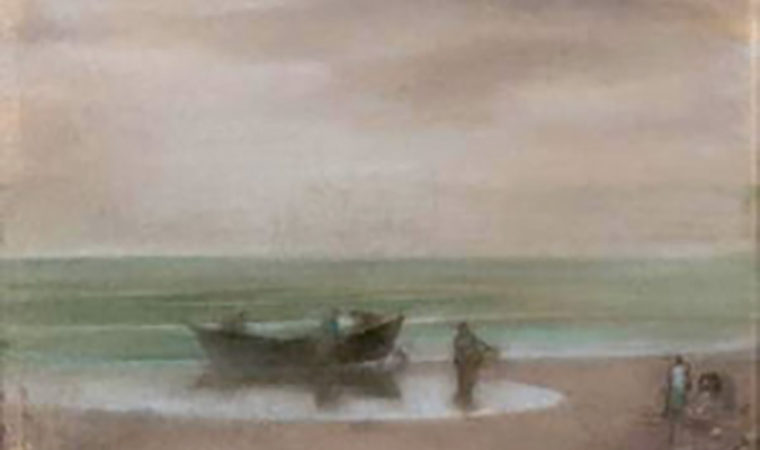
It would be twenty-four years before Niemeyer-Holstein was able to resume his personal contacts in Ticino and Florence. Further trips followed, yielding an impressive artistic harvest of around one hundred paintings and drawings. Particularly remarkable was a journey of several weeks that took him from Florence through Tuscany, across the Abruzzi to Apulia, and all the way to Sicily.
The exhibition and catalogue present works created by Otto Niemeyer-Holstein in Italy between 1920 and 1958, bearing witness to how deeply the longing for Italy captivated and shaped him. Many works have been framed and exhibited for the very first time especially for this occasion, complemented by loans from the Potsdam Museum, the Museum of Fine Arts Leipzig, and private collections.
Yet the conclusion he drew from his travels was always the same. As he wrote in an article for the journal “Bildende Kunst” (issue 3/1959): “It was only abroad that I truly realised I now want to paint the Usedom landscape — more than ever before.”